Sample Chess Game
This Sample Chess Game introduces a beginning chess player to algebraic chess notation and uses it to guide you step-by-step graphically through a short game. If you don't know how to play chess, Basic Chess Rules explains the rules of chess for beginners.
Age: Adults and older children
No. of players: 2 players
Equipment: Chess board and pieces. You can download a free printable chess set from our website.
Time: 10+ minutes
Aim: To learn algebraic chess notation and follow a sample chess game.

Subscribe to the RSS feed on the Navigation Bar over to the left
or bookmark this site (top of the right column) and visit often.
Algebraic Chess Notation is used internationally to describe the moves in a chess game. There are other forms of chess notation, but this is the most common. The Sample Chess Game below uses this notation.
1. Each square on a chess board is given a unique identification. The vertical files are named a to h from left to right. The horizontal ranks are numbered 1 to 8 from bottom to top. These designations are always given from the viewpoint of the White player, and diagrams of the board are always shown with the White player at the bottom.
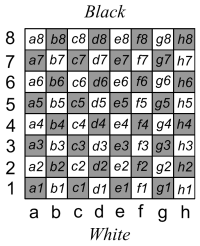
2. Chess pieces are identified by an upper case letter:
- King K
Queen Q
Rook R
Bishop B
Knight N (since K is used for the King)
3. Each move is designated by the piece's letter and its destination square. For example, if a Rook moves from h1 to h5, the move is Rh5. Similarly, Nf3 shows a Knight has moved to square f3 while e6 indicates a Pawn has moved to square e6.
4. The moves played by each player in one turn are described as a pair, with White's move first. For example, 3. Ng4 Bd3 shows that on the third pair of moves in the game, White moved a Knight to square g4 followed by the black Bishop to square d3. A series of moves can be written as vertical pairs or can be written horizontally. For example;
- 1. e4 e5
2. Nf3 Nc6
3. Bb5 a6
- 1. e4 e5 2. Nf3 Nc6 3. Bb5 a6
5. If there is any confusion concerning which piece is being described, the piece's letter is followed by the file and/or rank it left. For example, Ngf3 shows the Knight that was on file g has moved to f3, while Nhf3 would show that the Knight that was on file h has moved to f3. If the file is not enough to distinguish between two pieces, the rank of the piece is given instead. If you have three or more identical pieces (after a pawn promotion), you may need to use both file and rank to uniquely describe a piece.
6. If a piece is captured, the letter for the capturing piece is followed by an "x" (usually) or a ":" and the square where the capture occurs. For example, Nxd2 shows that a Knight has captured the piece that was on square d2. An en passant capture is usually shown by adding the letters "e.p." after the move.
7. A pawn promotion is shown by '=' or by simply naming the new piece. For example, a black pawn that reaches square c1 and is promoted to a Queen could be shown by c1Q or c1=Q. Other variations you may see for a pawn promotion are c1 (Q) or c1/Q
8. Castling is shown by 0-0 when castling kingside and 0-0-0 when castling queenside.
9. When a King is in check, it is usually indicated by plus sign "+" or by a dagger "†" or "ch". Checkmate can be indicated by a hash sign "#", a double plus sign "++" or a double dagger "‡". If a player resigns or loses because of time control, this may be shown by 1-0 if White wins or 0-1 if Black wins. ½-½ shows a draw.
Now that you have learned Algebraic Chess Notation you should be able to follow the sample chess game shown below.
Sample Chess Game
This sample chess game was played between Paul Morphy and his two opponents, the Duke of Brunswick and Count Isouard, in 1858 during a performance of The Barber of Seville at the Paris Opera.
- 1. e4 e5
2. Nf3 d6
3. d4 Bg4
4. d4xe5 Bxf3
5. Qxf3 d6xe5
6. Bc4 Nf6
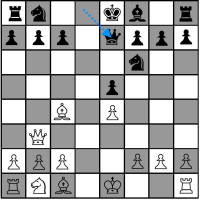
7. Qb3 Qe7
8. Nc3 c6
9. Bg5 b5
10. Nxb5 c6xb5
11. Bxb5+ Nd7
12. 0-0-0 Rd8
13. Rxd7 Rxd7
14. Rd1 Qe6
15. Bxd7+ Nxd7
16. Qb8+ Nxb8
17. Rd8#
The sample chess game above is shown step-by-step below with explanations. White's moves are shown with red arrows; Black's moves are shown with blue arrows.
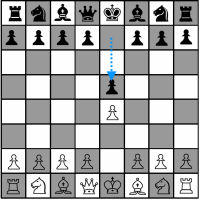
1. e4 e5
Both players have moved their pawns to oppose each other.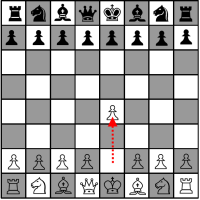
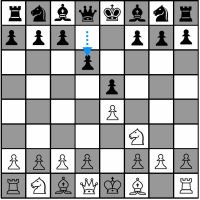
2. Nf3 d6
White has moved his Knight while Black moved a pawn one square.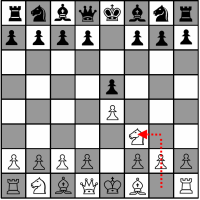
3. d4 Bg4
White moved a pawn two squares while Black moved his Bishop 4 squares.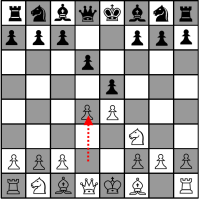
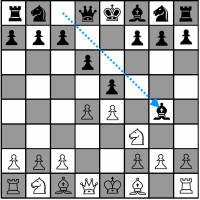
4. d4xe5 Bxf3
White captured a black pawn while Black moved his Bishop to capture the white Knight.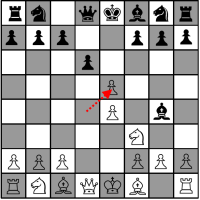
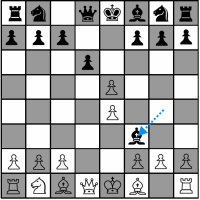
5. Qxf3 d6xe5
White's Queen captures the black Bishop while Black's pawn captures the white pawn.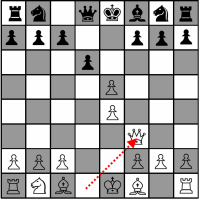
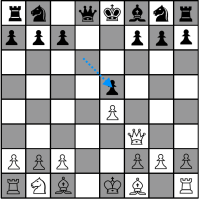
6. Bc4 Nf6
White moves his bishop and Black moves his Knight.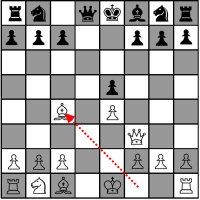
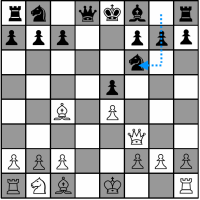
7. Qb3 Qe7
Both players move their Queens.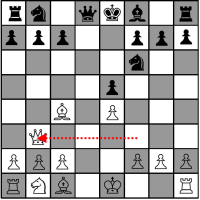
8. Nc3 c6
White moves his Knight while Black moves a pawn one square.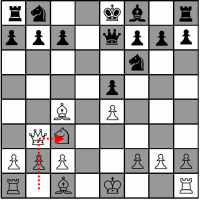
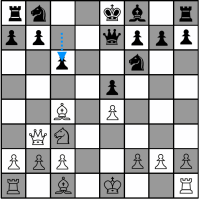
9. Bg5 b5
White moved his bishop while Black moved a pawn two squares.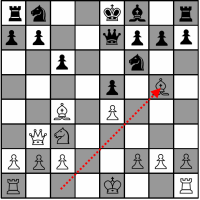
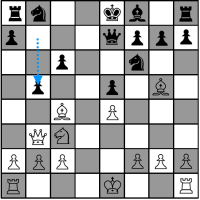
10. Nxb5 c6xb5
White captures a pawn with his Knight and immediately Black captures the Knight with a pawn.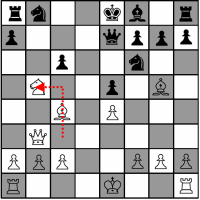
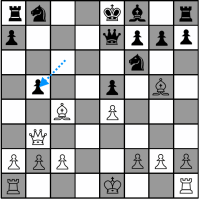
11. Bxb5+ Nd7
White captures the pawn with his Bishop and puts the black King in check (shown by the +), so Black moves his Knight to block the bishop.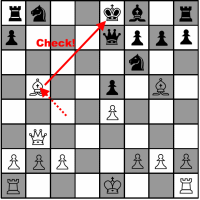
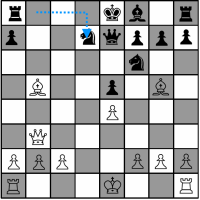
12. 0-0-0 Rd8
White castles queenside (0-0-0) while Black moves his Rook to help protect his King.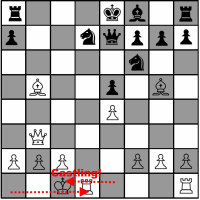
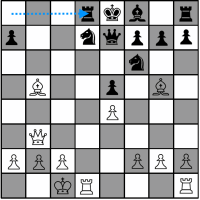
13. Rxd7 Rxd7
White captures the Knight with his Rook, and Black immediately captures the Rook with his own Rook.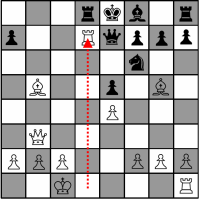
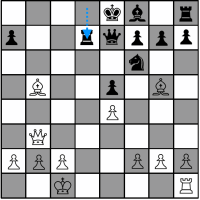
14. Rd1 Qe6
White moves his Rook and Black moves his Queen.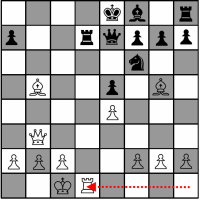
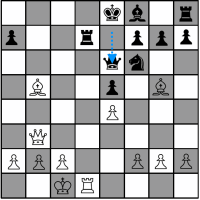
15. Bxd7+ Nxd7
White captures the black Rook with his Bishop (putting the King in check) and Black immediately captures the Bishop with his Knight.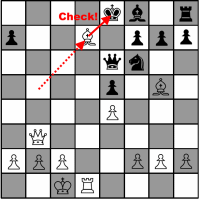
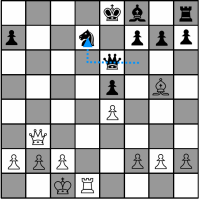
16. Qb8+ Nxb8
White moves his Queen and puts the black King in check again, but Black captures the Queen with his Knight.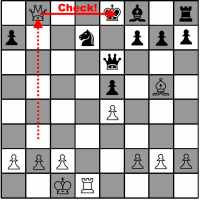
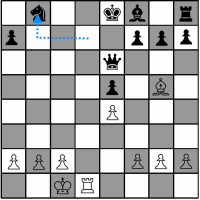
17. Rd8#
White moves his Rook and checkmates the black King.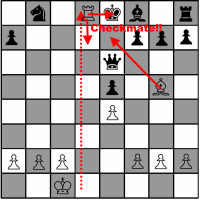
Although many of White's moves in this sample chess game may seem strange to a beginning chess player (such as intentionally losing a Queen) you should be able to see that there was a great deal of strategy and tactics involved. No wonder Paul Morphy was considered the unofficial World Chess Champion of his time and could easily win against two opponents working together. For more historical games using Algebraic Chess Notation, see ChessGames.com
The sample chess game shown above should convince you that you need to learn and develop good strategies. These strategies can be used throughout a game. Many common opening moves have been given names (such as the Philidor Defence or the Evans Gambit). As you develop your skills, you should learn opening, middle and end game strategies. A good resource is Expert-Chess-Strategies.com
 Click here for printer friendly version
| Click on the links below for more Family Board Games including. |
|
Do you have a favourite Board game that you want to share with all our readers? You can share YOUR Board game and/or check out other readers' favourite Board games. It's easy! Just click on this share YOUR Board game link and follow the instructions. |
Thank you for visiting our website!
Parlor Games | Board Games | Traveling Games | Tile (Domino) Games
Card Games | Worldwide Games | Outdoor Games | Dice Games | Word Games
Christmas Games | Easter Games | Thanksgiving Games
Family Reunion Games | Valentines Games
Great Gift Ideas
 Cashflow |
 Monopoly |
 Family Trampoline |
 Volleyball Set |
 Table Tennis Table |
Ebooks
 The Family Guide to Party Games |
 The Family Guide to Christmas Games (Volume 1) |
 The Family Guide to Christmas Games (Volume 2) |
 The Family Guide to Printable Board Games |
 The Family Guide to Printable Travel Games |

All rights and trademarks are the property of their respective owners.
All rights reserved
This site may receive compensation for some or all referred products.
The payment received from these products helps subsidise the running costs of the site.

Children are a heritage from the LORD